
The Digital Journal

Explore our latest thoughts on web design, digital strategy, branding, and performance marketing. From rapid-build websites to fully bespoke digital experiences, we share the expertise that helps businesses grow and stand out online.

What Is The 7 Times 7 Rule In Marketing?

Table Of Contents

The 7 times 7 rule in marketing suggests a potential customer often needs around seven exposures to your brand message across roughly seven touchpoints (or within a short period) before they recognise, trust, and act. Treat it as a planning guideline for consistent, multi-channel campaigns, not a fixed scientific law.

In modern digital marketing, “7x7” works best as a reminder to plan repetition with intention. Use multiple channels, clear sequencing, frequency controls, and creative variation to build familiarity without causing ad fatigue.

A Simple Definition (And Why It Exists)

The 7 times 7 rule (sometimes written as 7x7) is a campaign planning heuristic that suggests:

  • A prospect needs repeated exposure: Seeing your message several times helps them remember you and feel confident taking action.
  • Those exposures should happen across multiple touchpoints: A mix of paid, owned, and earned channels usually works better than repeating the same ad in the same place.
  • Consistency matters: Your core promise and positioning should stay clear, even when formats change.

Important clarification: An “exposure” can be a simple impression (an ad served). A “touchpoint” is usually a more meaningful interaction, such as a page visit, video view, email click, webinar attendance, or store visit. Good 7x7 planning aims for quality touchpoints, not just more impressions.

Is It The Same As The “Rule Of 7”?

They are closely related. In practice, people often use the “7 times 7 rule” and the “Rule of 7” to mean the same thing: customers typically need multiple encounters with a brand before converting.

7x7 Vs Rule Of 7 Vs “Effective Frequency” (What Each Means)

  • Rule of 7: A classic marketing idea that prospects need to see or hear a message about seven times before they act.
  • 7 Times 7 (7x7): A modern spin that often implies seven exposures across seven touchpoints, or seven touches over a defined period (such as a week or two).
  • Effective Frequency: A media planning concept for the number of exposures needed before advertising has a meaningful effect, after which extra frequency brings diminishing returns.

Think of 7x7 as a planning framework, and effective frequency as a measurement and optimisation concept.

Where Did The 7x7 Idea Come From (And Is It Backed By Evidence)?

The “seven touches” concept is often linked to traditional advertising eras like film, radio, and early TV. Repetition mattered because audiences had fewer ways to research brands instantly.

Is it evidence-based? Partly. The exact number “7” is not a universal truth, but the principle that repetition builds familiarity is supported by behavioural science. One well-known explanation is the mere-exposure effect. People often develop a preference for things simply because they have encountered them repeatedly. See: Encyclopaedia Britannica’s overview of the mere-exposure effect.

For broader advertising effectiveness thinking, the UK advertising industry also publishes evidence-led guidance and research summaries through the IPA (Institute of Practitioners in Advertising) Knowledge hub.

Why ‘7’ Is A Guideline, Not A Magic Number

The real number of touches you need varies based on:

  • Category and price point: A takeaway order and a five-figure B2B contract have very different decision cycles.
  • Audience awareness: Warm audiences need fewer touches than cold audiences.
  • Creative quality and clarity: Strong, distinctive creative can reduce the number of exposures required.
  • Channel mix and intent: A high-intent search click is not the same as a low-attention display impression.
  • Competition and noise: Crowded markets often require more repetition to stay memorable.

Why Repetition Works: Familiarity, Trust And Memory

    Repetition works because buying decisions are rarely purely rational. People often choose brands that feel familiar, credible, and easy to recall at the moment of choice.

    Brand Recall And Salience

    When your brand shows up consistently in relevant places, you build:

    • Recall: People remember you without being prompted.
    • Recognition: People know it is you when they see you in a search result, on social, or in their inbox.
    • Salience: Your brand comes to mind in the buying situation, not only when someone sees an ad.

    Short Buying Cycles Vs Long Consideration Journeys

    • Short buying cycle (B2C, low friction): You may compress touches into 3 to 10 days and focus on availability, offer, and convenience.
    • Long consideration journey (B2B, high value): Touches may be spread across 30 to 180 days and supported by proof points such as case studies, webinars, and stakeholder-friendly content.

    How To Apply The 7 Times 7 Rule In Modern Digital Marketing

    The best way to use 7x7 is to design a multi-touch sequence that moves someone from awareness to action. Control frequency and avoid repetition fatigue.

    Step 1: Define Your Audience And One Core Message

    Start with one clear message you can repeat across formats. For example:

    • Who: “UK SMEs hiring their first marketing manager.”
    • Problem: “Lead flow is inconsistent month to month.”
    • Promise: “Predictable pipeline through integrated search and paid social.”
    • Proof: “Case studies, testimonials, measurable reporting.”

    If you need help tightening your positioning and channel plan, explore digital marketing services with Digital Five.

    Step 2: Map 7 Touchpoints (Paid, Owned And Earned)

    Plan touchpoints across:

    • Paid: PPC, paid social, display, YouTube, sponsorships.
    • Owned: Website, landing pages, email, webinars, brochures, customer portal.
    • Earned: SEO rankings, reviews, PR mentions, partner referrals.

    Make sure each touch has a job to do. For example, it might educate, prove credibility, remove objections, or prompt a demo request.

    Step 3: Plan Frequency And Sequencing (What Comes First, Second, Third)

    A practical way to sequence a 14 to 30 day campaign:

    • Touches 1 to 2 (Awareness): Broad targeting on paid social, plus a short video explaining the problem you solve.
    • Touches 3 to 4 (Consideration): Retargeting to a guide, checklist, or case study, with search ads capturing active intent.
    • Touches 5 to 6 (Decision): Email nurture with proof points and FAQs, plus a conversion-focused landing page.
    • Touch 7 (Action): A strong call to action, such as “Book a call” or “Get a quote”, reinforced via remarketing.

    For channel-specific support, see Digital Five’s Pay Per Click services and Social Ads.

    Step 4: Align Creative Variations To Avoid Fatigue

    Keep the message consistent, but rotate the creative. Common variations include:

    • Different hooks: Lead with time savings, revenue growth, risk reduction, or simplicity.
    • Different proof: Testimonials, case studies, statistics, before and after snapshots.
    • Different formats: Video, carousel, static, short-form, long-form, landing page variants.

    This reduces “same-ad burnout” while preserving recognition.

    Examples Of 7x7 Touchpoints (B2B And B2C)

    B2B Example: Service Business Generating Leads
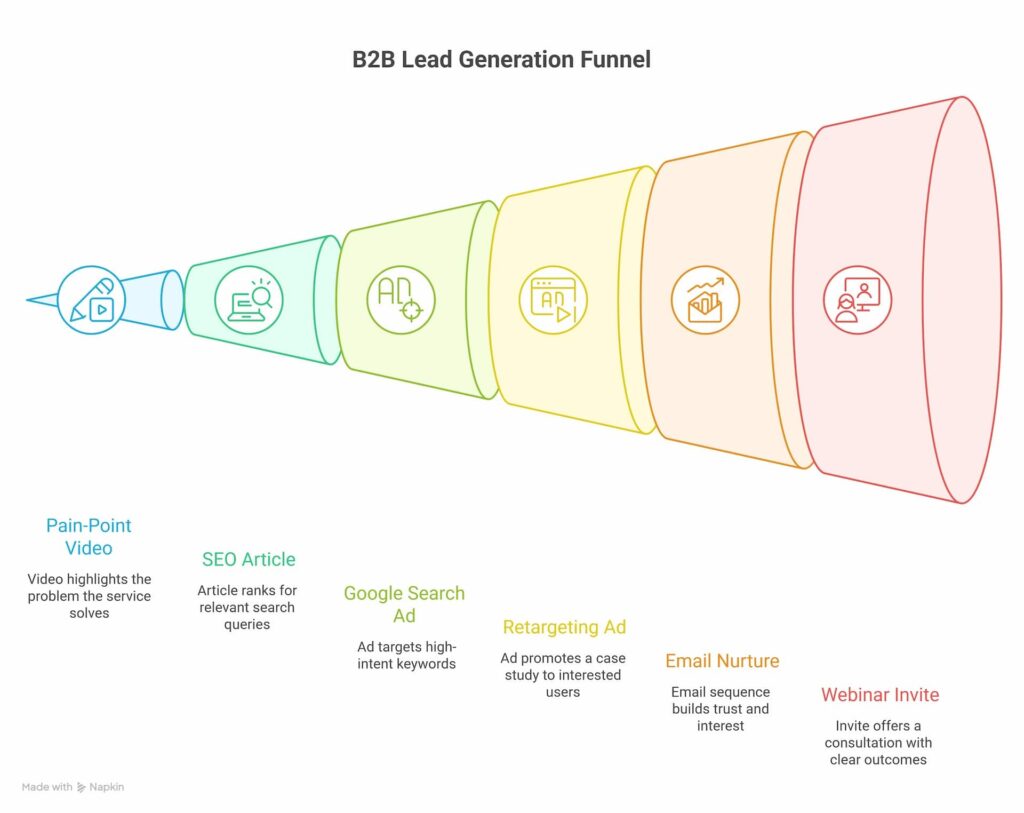
    Service business generating leads Southampton

    Scenario: A professional services firm wants more qualified enquiries for a specialist service.

    • Touch 1: LinkedIn awareness ad leading to a pain-point video.
    • Touch 2: SEO article ranking for a “how to choose” query.
    • Touch 3: Google Search ad for high-intent keywords.
    • Touch 4: Retargeting ad promoting a case study.
    • Touch 5: Email nurture sequence after a content download.
    • Touch 6: Webinar or consultation invite with agenda and outcomes.
    • Touch 7: Conversion landing page with testimonials and a simple booking form.

    Worked measurement example (illustrative, not a benchmark):

    • Reach: 12,000 relevant professionals over 30 days.
    • Average frequency: 5.5 across paid channels (social plus display remarketing).
    • Branded search lift: 20% increase in “brand name + service” queries compared to the previous month.
    • Outcome: More enquiries attributed to a combination of search clicks and view-through assisted conversions.

    If you want to see the type of work Digital Five delivers, browse our portfolio.

    B2C Example: Local Retailer or E-commerce
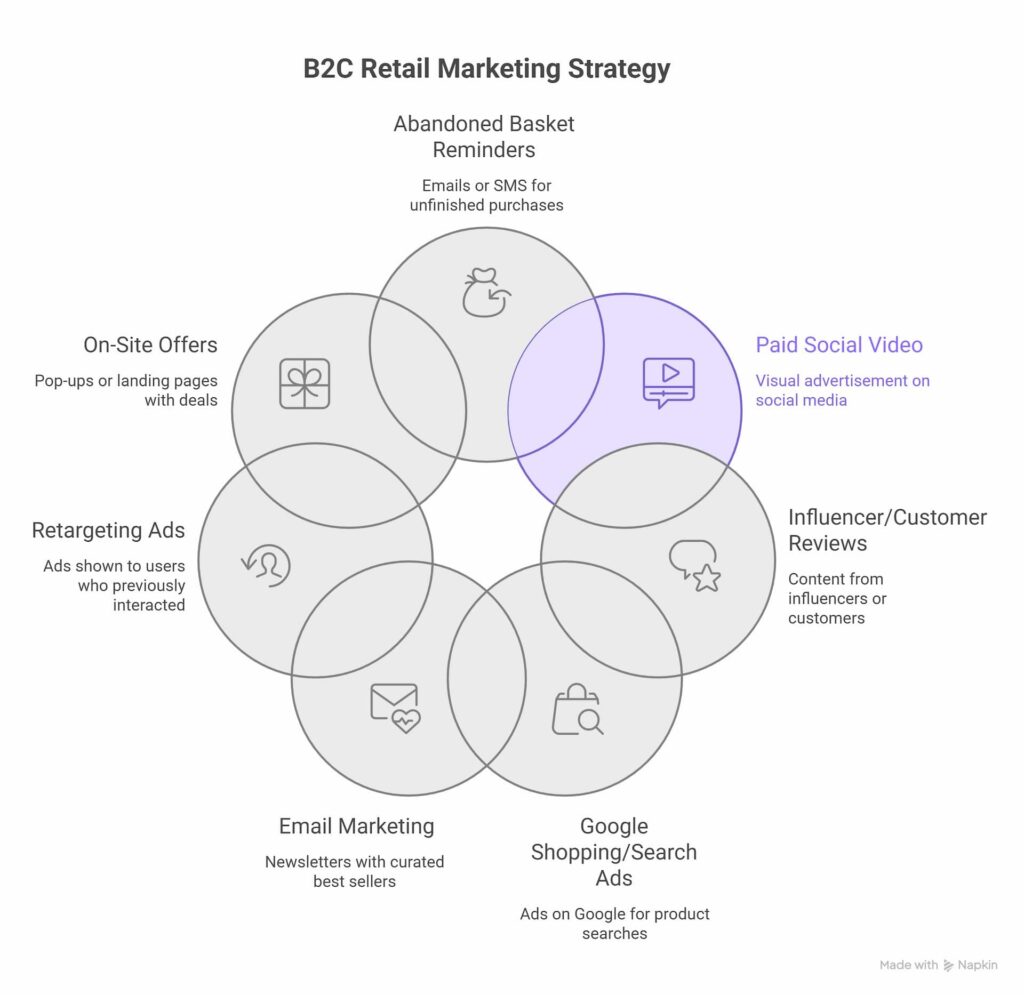
    Local retailer or e commerce Southampton

    Scenario: A retailer promotes a seasonal product range.

    • Touch 1: Paid social video showing the range.
    • Touch 2: Influencer or customer review content (earned or paid partnership).
    • Touch 3: Google Shopping or Search ads for product intent.
    • Touch 4: Email to subscribers with curated best sellers.
    • Touch 5: Retargeting with dynamic product ads.
    • Touch 6: On-site pop-up or landing page offer with clear delivery and returns information.
    • Touch 7: Abandoned basket email or SMS reminder (where consent exists).

    To ground this in real-world behaviour, UK channel usage and media consumption patterns are tracked in sources like Ofcom’s research and data. This is useful when choosing touchpoints your audience is most likely to see.

    Channel Ideas You Can Use As The ‘7’

    Your “seven” does not have to mean seven separate platforms. It can be seven meaningful touches across a smaller set of channels, as long as the journey stays coherent.

    Search (SEO + PPC)
    Seo and ppc agency Southampton

    • SEO touchpoints: Helpful guides, comparison pages, FAQs, and case studies that answer real questions.
    • PPC touchpoints: Capture high-intent demand with search ads and support with remarketing.

    For long-term demand capture, see Search Engine Optimisation (SEO).

    Paid Social And Remarketing
    Social media advertising agency Southampton

    • Awareness: Broader targeting to introduce the message.
    • Consideration: Retarget video viewers and site visitors with proof-focused creative.
    • Decision: Retarget product or pricing page visitors with a strong call to action.

    Use frequency caps where possible, and rotate creatives to avoid fatigue.

    Email Marketing And Automation

    Email marketing agency Southampton

    • Nurture sequences: 4 to 7 emails over 14 to 30 days in many B2B contexts.
    • Behavioural triggers: Follow-ups based on page visits, downloads, or abandoned baskets (with consent).

    Content Marketing (Guides, Case Studies, Video)

    Content marketing agency Southampton

    • Guides: Explain the problem and solution.
    • Case studies: Prove outcomes and reduce perceived risk.
    • Video: Build familiarity quickly, especially for top-of-funnel activity.

    Landing Pages And Conversion-Rate Optimisation
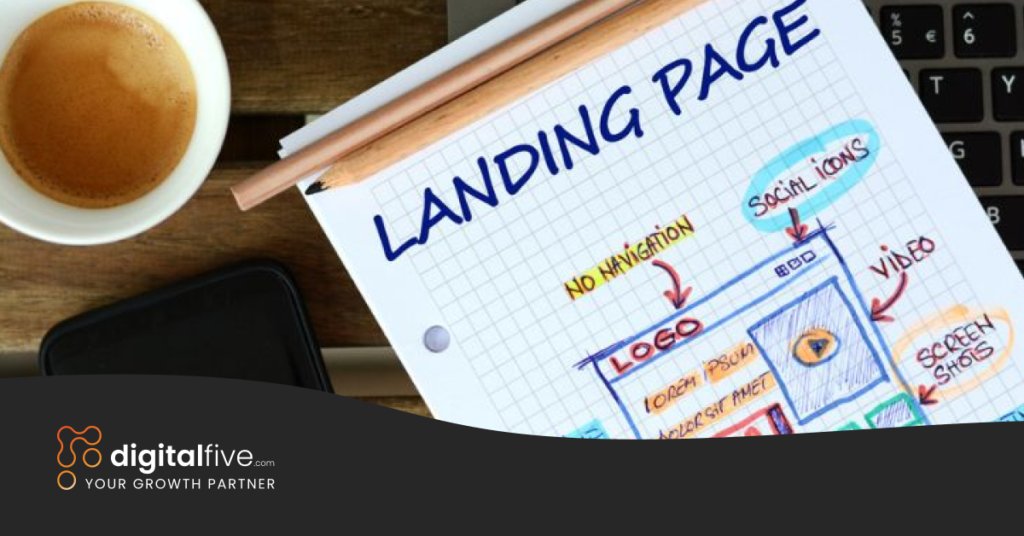
    Landing page conversion experts Southampton

    • Message match: Ensure the ad promise and landing page headline align.
    • Friction removal: Shorter forms, clearer pricing signals, trust markers, and faster load times.
    • Testing: Test one element at a time to understand what improves conversion.

    If you need a combined approach to your website and campaigns, explore Web and Marketing with Digital Five.

    Offline Reinforcement (Events, Print, Direct Mail)

    • Events: A stand conversation can count as several digital “touches” in terms of trust building.
    • Print and direct mail: Useful for local markets or high-value B2B when targeted carefully.
    • Consistency: Use the same key message and visual identity as your digital assets.

    How To Measure Whether You’re Hitting The Right Frequency

    Measuring the “right” frequency is less about reaching seven exactly. It is about finding the point where extra impressions stop improving outcomes.

    Key Metrics: Reach, Frequency, Impressions, View-Through, Branded Search

    • Reach: How many unique people saw your ads?
    • Frequency: The average number of times each person saw your ads.
    • Impressions: Total ad views served, including repeats.
    • View-through conversions: Conversions after an ad view without a click (platform-defined, so interpret carefully).
    • Branded search demand: Increases in searches for your brand, or brand plus service.

    When evaluating reach and frequency trade-offs, measurement organisations such as Nielsen Insights often discuss how advertisers balance scale, repetition, and effectiveness.

    Effective Frequency And Diminishing Returns

    Watch for signs you have passed effective frequency:

    • Rising frequency with falling click-through rate: People see the same message and ignore it.
    • Conversion rate drops while impressions increase: You may be over-serving the same prospects.
    • Cost per acquisition increases: You pay more for the same outcomes.
    • Negative feedback grows: Hides, blocks, or complaint signals increase on social platforms.

    Practical controls include frequency caps (where available), audience exclusions (exclude converters), creative rotation, and shorter remarketing windows for fast-moving purchases.

    Attribution Considerations (What 7 Exposures Looks Like In Reporting)

    Attribution often undercounts “touches” because:

    • Cross-device journeys are messy: Someone might see ads on mobile but convert on desktop.
    • Walled gardens limit visibility: Platform reporting does not always join journeys together.
    • Not every touch is trackable: Offline conversations, dark social sharing, and brand recall effects may not show up directly.

    To improve decision-making, combine:

    • Platform data: In-platform frequency and engagement signals.
    • Web analytics: On-site behaviour, assisted paths, and landing page performance.
    • Incrementality tests: Where possible, use holdouts or geo splits to understand what drives additional conversions.

    Privacy note: If you use remarketing, make sure your approach respects consent and data protection requirements. For UK organisations, it is sensible to review regulator guidance and keep tracking transparently and proportionately.

    Common Mistakes (And How To Avoid Them)

    Over-Frequency And Ad Fatigue

    • Mistake: Serving the same ad to the same people too often.
    • Fix: Cap frequency, rotate creative, broaden audiences, and refresh offers.

    Repeating The Wrong Message

    • Mistake: Repeating a vague slogan with no clear value.
    • Fix: Repeat one strong promise, then vary proof points and use-cases.

    Too Many Channels, Not Enough Consistency

    • Mistake: Posting everywhere with different messaging and no coherent journey.
    • Fix: Choose fewer, higher-quality touchpoints and align them to one narrative.

    Practical 7x7 Checklist For Your Next Campaign

    • One core message defined: A single promise you can repeat consistently.
    • Clear audience segments: Cold, warm, and existing customers separated.
    • Seven meaningful touches mapped: A blend of paid, owned, and earned.
    • Sequencing planned: Awareness, then consideration, then decision assets.
    • Frequency controls set: Caps, exclusions, and remarketing windows.
    • Creative rotation ready: Multiple formats and proof angles prepared.
    • Measurement plan agreed: What success looks like and how it will be tracked.

    Want a second pair of eyes on your plan? Talk to Digital Five via Contact Us.

    When The 7 Times 7 Rule Won’t Fit (And What To Do Instead)

    There are situations where “seven touches” is either too many or not enough. Instead, base your frequency on buying behaviour, audience size, and creative performance.

    Low-Consideration Purchases Vs High-Value Decisions

    • Low-consideration: Aim for fewer touches, tighter windows, and strong availability and offer messaging.
    • High-value: Spread touches over longer periods and prioritise credible content, including proof, process, and risk reduction.

    Niche Audiences And Limited Reach

    • Challenge: Small audiences can hit high frequency quickly, which causes fatigue.
    • Approach: Broaden targeting slightly, tighten exclusions, expand content formats, and invest in SEO to capture demand without over-serving ads.

    FAQs About The 7 Times 7 Rule In Marketing

    It depends. Some purchases happen after 1 to 2 high-intent touches, such as a search click to a strong landing page. Others take dozens of touches across multiple stakeholders. Use 7×7 as a starting point, then optimise based on conversion rate, cost per acquisition, and signs of fatigue.

    Fun Fact: The Rule Of 7 Has A Psychology Twin

    The “Rule of 7” is often linked to old-school film and radio advertising. Its underlying logic matches a real psychology finding: people tend to prefer things simply because they have been exposed to them repeatedly (the “mere-exposure effect”), even when they do not consciously notice it.

    Conclusion

    The 7 times 7 rule is not a strict formula. It is a helpful prompt to build consistent, multi-touch marketing where your audience sees the right message often enough to remember and trust you. Use it to map touchpoints, plan sequencing, measure effective frequency, and protect performance by avoiding ad fatigue.

    If you would like Digital Five to help you design a campaign that balances reach, frequency, and conversion, learn more about us or get in touch via Contact Us.

    Mini Glossary

    • Reach: The number of unique people who see your marketing.
    • Frequency: The average number of times each person sees your marketing.
    • Impressions: The total number of times ads are served, including repeats.
    • Effective Frequency: The approximate number of exposures needed before marketing starts to meaningfully influence outcomes.
    • Ad Fatigue: A performance decline caused by over-exposing the same audience to the same creative.
    • Sequencing: Delivering messages in an intentional order, awareness, then proof, then action.